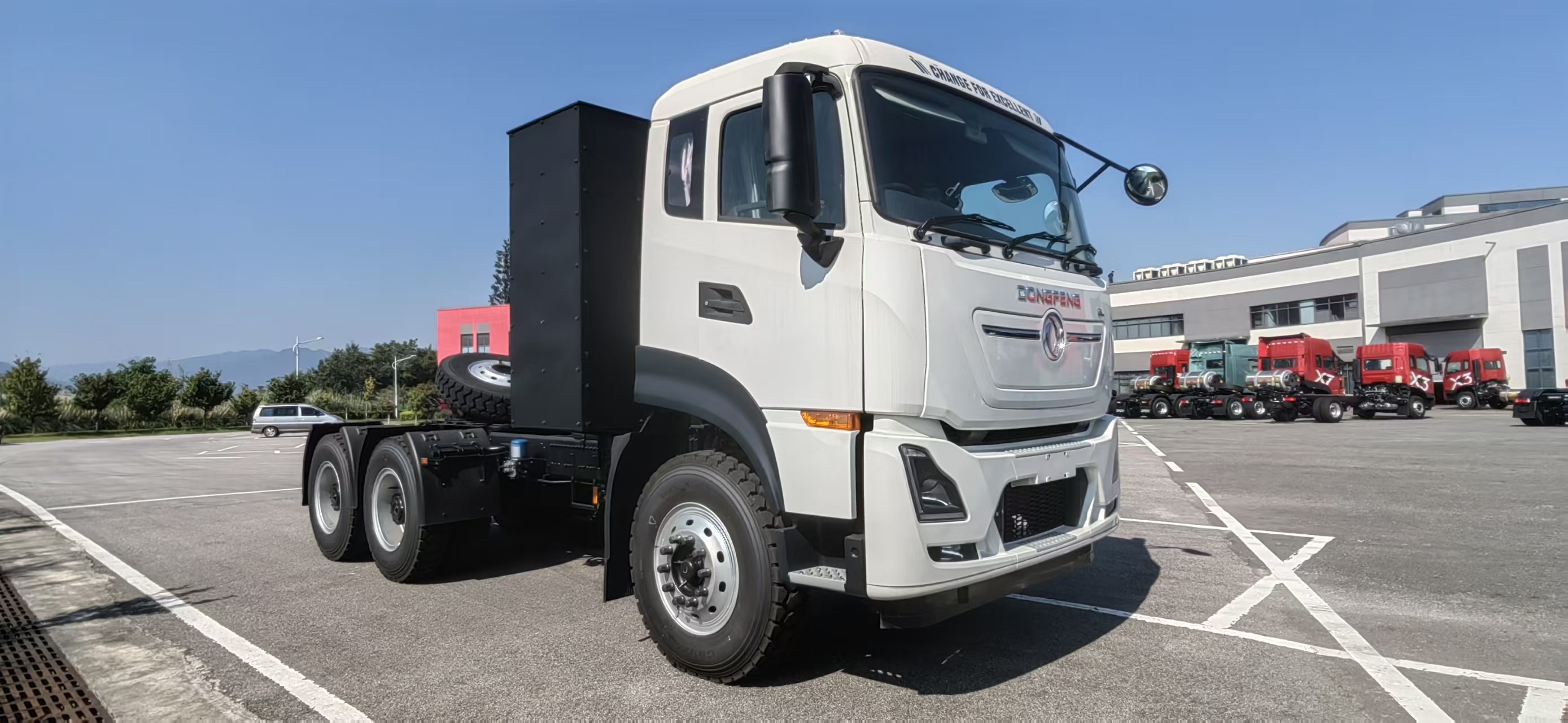
Use the signed order as the inspection baseline
Inspect the truck against the final purchase order and approved build sheet—not a product-family description or a reference photograph. As an example, the customer-provided TE9Y worksheet lists the following fields. They illustrate what to reconcile and do not establish that any particular production vehicle has passed inspection.
| TE9Y worksheet field | Listed reference | Inspection / document check |
|---|---|---|
| Model | DFH4250YBEV8-TE9Y-902 | Match build plate, order and chassis identity |
| Configuration | 6×4 electric tractor | Verify axle layout, steering side and ordered variant |
| GCW | 120,000 kg listed | Confirm signed rating documents; not payload |
| Battery capacity | 600.92 kWh listed | Match battery identification and supplied records |
| Motor | 315 kW rated / 510 kW peak listed | Confirm component/build documentation |
| Charging | Dual-gun DC, 600 A listed | Inspect ordered inlets and supplied cables; clarify rating basis |
| Dimensions | 7,795 × 2,550 × 3,270 mm listed | Compare to approved drawing and agreed measurement method |
The original TE9Y configuration article explains which worksheet values remain unverified for a delivered build. If a signed order differs from this reference, inspect against the signed order.
Agree the inspection scope before the appointment
Set the date, location, people, safe access, inspection duration and acceptance criteria in writing. Identify who can power up the vehicle, retrieve diagnostic information and demonstrate charging. Agree whether the buyer may use an independent inspector, what tools are allowed, how defects are recorded and who approves corrective work. Use trained personnel for high-voltage equipment; a visual inspection is not permission to open battery enclosures or touch high-voltage components.
Prepare the final specification, options list, approved drawings, purchase order, delivery checklist and any destination-specific document requests. Create a discrepancy log with item, evidence, severity, responsible party, due date and closure proof. Agree how unresolved issues affect dispatch authorization under the contract. Do not rely on informal chat messages as a substitute for the agreed acceptance record.
Verify vehicle identity and physical condition
Match the vehicle identification and chassis/build information to the order and shipping documents. Check steering position, axle configuration, cab, exterior panels, glass, lamps, mirrors, tyres, wheels, steps, guards and visible fasteners against the ordered specification. Inspect for damage, corrosion, fluid leaks, loose parts or transport marks, recording location and condition with dated photographs where permitted.
Review the chassis and fifth-wheel area, coupling hardware, air and electrical lines, frame attachments and access panels. Confirm that visible options and customer-specified equipment are present. For a body or PTO requirement, verify the approved interface documents and installed components separately; the TE9Y reference worksheet does not confirm PTO equipment. Check that plates and labels are legible and match the documentation, but let the destination-market partner determine the required labels and approvals.
Where measurements matter, use the agreed method and calibrated equipment. Record the actual measured dimension, tolerance and reference drawing rather than marking an item simply “OK.” Avoid interpreting a single visual measurement as legal certification.
Check electric-vehicle records and charging interfaces
Request the vehicle maker's handover procedure for battery state, storage, isolation, inspection and transport. Record the displayed state of charge and any available battery or diagnostic report as permitted by the agreed protocol. Compare identifiers in supplied documents with the installed unit labels. Do not assume every battery record is available to a buyer or that a capacity entry equals usable energy.
Inspect the exterior condition of charging inlets and confirm that the ordered connector type, protective caps and supplied accessories are present. If a charging demonstration is included, use the approved charger and supplier procedure. Record the charger model, connection, communication result, session start/end, displayed energy and warnings; a successful short session does not prove full route range or complete site compatibility. For additional questions, see the electric truck charging compatibility checklist.
Request the manuals, warning definitions, emergency information, maintenance schedule and service contacts specified by the order. Confirm driver and technician training scope and make sure the handover explains who may perform repairs. Follow the manufacturer's procedures for any warning; do not clear faults merely to complete an inspection.
Reconcile documents, accessories and destination requirements
Check the contractually agreed commercial and technical document list: final build specification, manuals, component records, warranty documents if included, packing list, keys, tools, spare items and charger accessories. Record missing or damaged items. Confirm the actual serial/model references against the vehicle and the document pack.
Import, registration, homologation, tax, customs, road access and oversize or combination permissions depend on destination and current rules. A factory inspection cannot guarantee these approvals. Ask the importer or qualified local compliance partner to confirm requirements for the exact completed vehicle and intended route before shipment. For Pakistan projects, the TE9Y route and charging plan lists additional project information to prepare, but it is not a regulatory determination.
Close the inspection with a traceable handover
Walk through each item and mark pass, fail, not applicable or pending evidence. Attach photographs, measurement sheets and diagnostic records to the inspection report. Describe defects precisely and agree corrective action, owner, completion date and reinspection method. Keep a copy signed by the relevant parties and link it to the purchase order and shipping file.
Before dispatch, reconcile unresolved items with the contract and the buyer's authorized acceptance decision. Record the vehicle's final condition, odometer or operating hours if available, state of charge under the manufacturer's transport guidance, keys/accessories transferred, and shipping preparation steps. At destination, perform a second condition review before commissioning because transit can introduce new damage or missing items.
This process helps organize evidence; it is not a legal certificate or independent quality guarantee. The inspection standard, tolerances, tests and remedies should be agreed by the buyer and supplier for the specific order.
Printable inspection checklist
- Order, signed configuration, build identity and vehicle plates match.
- Steering, axle layout, dimensions and ordered options are reconciled.
- Exterior, cab, chassis, coupling, tyres and visible components are documented.
- Battery and charging records follow manufacturer-approved procedures.
- Connectors, accessories, manuals, keys and agreed spares are present.
- Warnings, demonstration results, defects and corrective actions are recorded.
- Destination-market documents and approvals are checked by the local partner.
- Final acceptance, shipment condition and receiving inspection responsibilities are signed.
To prepare a configuration-specific checklist, send the model, order specification, destination country, inspection location and requested tests using the configuration enquiry page. Browse the electric tractor range or special-purpose electric truck range for related applications.
Frequently asked questions
Does a pre-shipment inspection guarantee approval in my country?
No. Import, registration, homologation, customs and route approval must be confirmed separately for the destination and completed vehicle.
Should I demand a fully charged battery before shipping?
Follow the manufacturer's written storage and transport instructions. Record the condition and state of charge; there is no universal target in this article.
Can the buyer inspect inside the battery enclosure?
Only if the manufacturer-approved process, qualified personnel and agreed scope permit it. A buyer should not open high-voltage equipment independently.
PRE-SHIPMENT REVIEW
Preparing to inspect an electric truck?
Share the signed specification, destination and acceptance scope to prepare a model-specific checklist.
Request a Configuration