Start with the operating cycle, not the battery headline
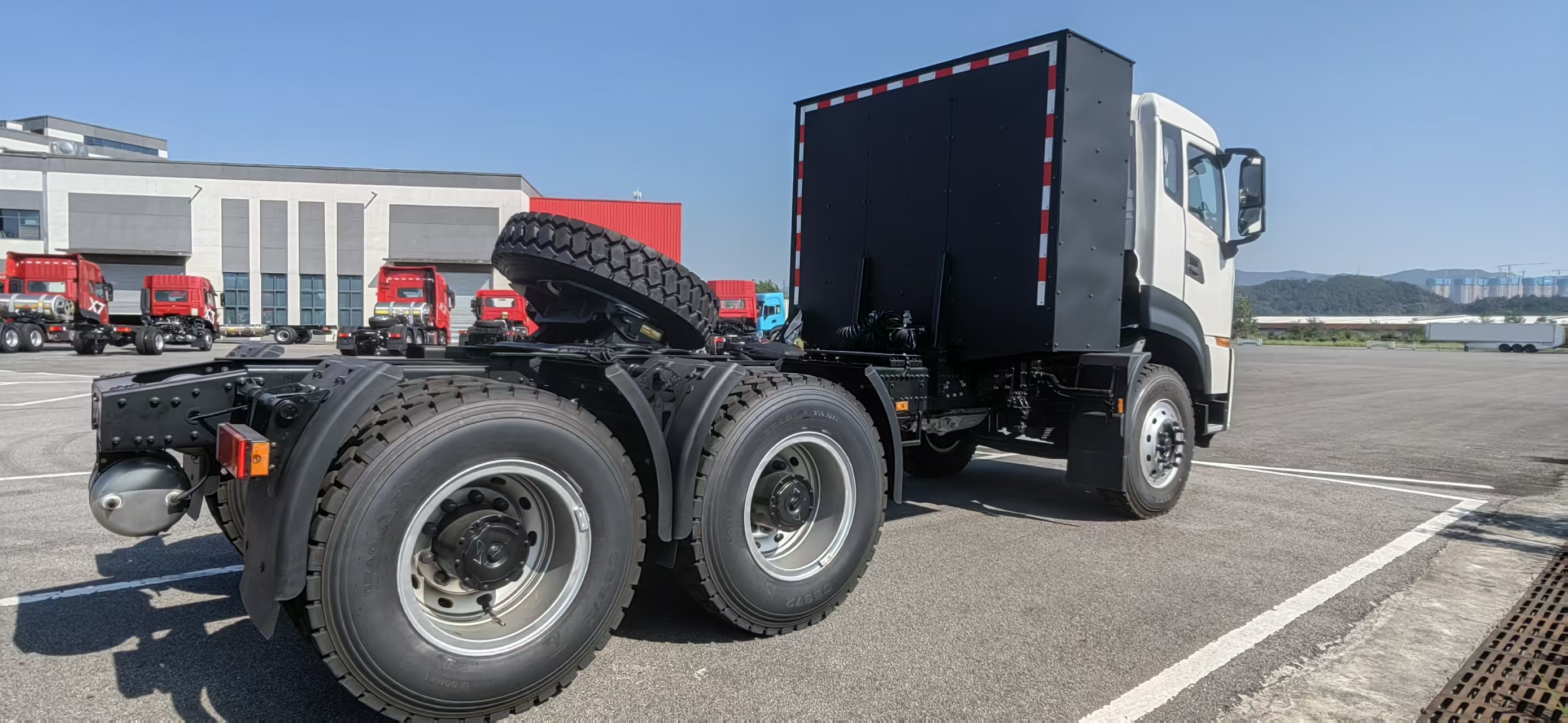
An electric tractor project is a transport-and-energy system: tractor, trailer, payload, road, schedule, chargers, electrical service and maintenance support. The supplied Dongfeng TE9Y configuration is a 6×4 tractor listed at 120,000 kg gross combination weight, with a 600.92 kWh battery and dual-gun 600 A DC charging. Those details make it a candidate to assess for heavy combination work; they do not demonstrate that it can complete a particular Pakistan route on one charge.
Write down the operation before requesting a final recommendation. Identify origin and destination, one-way and round-trip distance, loaded and empty legs, target combination mass, trailer, stops, turnaround time, number of shifts, overnight parking and any intermediate dwell. Note the road's elevation profile and surface condition, traffic pattern, gradients, access constraints and seasonal conditions that may affect energy or charging. Avoid broad labels such as “long haul” where a route map and trip log can be provided.
Separate known values from assumptions. If daily distance is an estimate, label it as such. If payload varies, capture a normal and a demanding case. If the driver waits with cab or auxiliary equipment operating, record that activity. This makes the feasibility discussion honest and gives a pilot a testable baseline.
Build a route evidence pack
For each route, prepare a map plus a simple trip sheet. Include planned departure and arrival times, distance by segment, loaded mass, expected speed band, elevation gain and loss, long climbs, stops, queuing and any rest or driver change. Record where the vehicle can safely park and whether a charger is realistically accessible during the duty window. A map distance alone omits many of the conditions that drive energy use and operational reliability.
For a high-mass combination, route access is also an approval and infrastructure question. Ask a qualified local partner to verify the exact tractor, trailer, axle loads, dimensions, bridge and road restrictions, terminal access and current requirements for each proposed route. Do not infer that a 120 t GCW figure means the combination may use any road or that every route has the same mass limit. This guide does not claim approval for any named Pakistani road, bridge or corridor.
Run the route assessment for a typical duty and a conservative normal duty, not an implausible worst-case stacked with every extreme. Define the operating conditions behind each case. If the work includes a return leg, account for it separately: a loaded uphill outbound leg and empty return can have different energy profiles, and regeneration should not be assumed to cancel the difference.
Use measured energy to create a range envelope
The workbook gives battery capacity but not a validated range. To estimate energy, use representative vehicle data or an engineering assessment from a pilot. A transparent trip-energy equation is:
Trip energy = loaded distance × measured loaded energy per kilometre + empty distance × measured empty energy per kilometre + measured auxiliary and idle energy.
Keep the source, test conditions and units for each input. Do not borrow a consumption value from a lighter vehicle, another trailer or a different route. If reliable measurements do not exist, mark the result “not yet validated” and gather the data instead of publishing a speculative distance.
Compare the estimated trip demand with the ordered battery's confirmed usable-energy range and a fleet-defined reserve. The listed 600.92 kWh should not automatically be treated as all energy available to dispatch: ask for the usable-energy definition, SOC limits, temperature conditions and any operating restrictions for the final build. Model contingency energy for a diversion, delayed loading, charger outage or return to a safe charging location. The reserve policy should be decided before deployment, not improvised when the truck is low on charge.
Track more than state of charge. Log distance, payload or combination mass, energy delivered, departure and arrival SOC, ambient conditions, route, travel time, average speed, stop duration and auxiliary usage. Review results by route segment and driver shift. A range envelope should show a planning case and a conservative case, with assumptions visible to dispatchers.
Translate “dual-gun 600 A” into a site plan
The TE9Y worksheet lists dual-gun 600 A DC charging. It does not specify the voltage, charging curve, connector, communications protocol or whether 600 A is a per-gun or combined rating. Do not multiply current by an assumed voltage or divide battery capacity by a guessed power to advertise a charge time. Request the vehicle's charge acceptance curve and confirm the precise meaning of the current entry for the build.
For each depot or intermediate site, identify the electrical connection, available capacity, transformer and switchgear constraints, charger model, connector and communications. Ask the utility and qualified electrical designer to confirm the service and installation pathway for that site. Include cable reach, vehicle parking orientation, access, weather protection, isolation, emergency shutoff, maintenance access and safe traffic flow around charging bays. Treat the charger and truck as one compatibility project and require an acceptance test before regular service.
Calculate the charging window from the operating schedule: arrival, parking, checks, driver shift, loading, maintenance and next dispatch. Confirm that the charging equipment can replenish the measured energy needed for the next duty within that actual window, with a contingency for equipment unavailability. If multiple vehicles will charge at the same time, document load management and simultaneous-power assumptions. A nameplate current figure alone does not establish the site's daily throughput.
Review the electric truck charger compatibility checklist and 600 kWh tractor depot charging plan as companion references. Both emphasize verifying the vehicle interface and operating schedule rather than relying on capacity figures alone.
Match mass, trailer and equipment to the work
The supplied TE9Y file lists 120,000 kg GCW, a 14,450 kg tractor kerb weight, dimensions of 7,795 × 2,550 × 3,270 mm and a 3,800 + 1,450 mm wheelbase. It also lists front DF701S / 7 t and rear DF300H / 25 t × 2 axle references. Confirm whether those axle figures describe component ratings or another basis, and obtain final axle-load and mass documentation for the completed vehicle. Do not treat the difference between GCW and tractor kerb weight as cargo payload: the trailer, load placement, coupling and legal limits are still unaccounted for.
Request a dimensioned configuration drawing and match it to the selected trailer. Check fifth-wheel position, kingpin, turning envelope, coupling height, tyre and suspension specification, braking integration, electrical connectors and any auxiliary equipment. Where these details are absent or unclear in the supplied worksheet, have the supplier resolve them in the signed technical schedule. If the route requires a body or additional power take-off equipment, treat it as a separate engineering review because it can change mass and energy demand.
Use a controlled pilot to replace assumptions
Before scaling a fleet, agree on a representative pilot route, test payload, trailer and data plan. Define the dispatch and reserve criteria, charge-site readiness, driver instruction, safety procedures, measurement method and success thresholds in advance. Capture several operating cycles across the conditions that matter rather than relying on a demonstration run. Ensure the test respects all applicable approvals and safety requirements.
Review the results jointly with operations, charging, maintenance and finance. Look at energy per kilometre by route segment, charging dwell, charger uptime, schedule adherence, payload or combination constraints, driver feedback and maintenance events. Keep the raw observations and the conditions behind them. If a result depends on an unrepeatable condition, don't make it the planning baseline.
After the pilot, revise the route-energy envelope, charging schedule and reserve. Confirm whether a single depot charger is sufficient or whether the route needs a different charging arrangement. If service or charger access is unavailable at a key point, record that operational gap before making a procurement decision. Battery sizing and route design should respond to evidence from the actual mission.
Pakistan electric tractor project checklist
- Route maps and trip records with loaded and empty distances, grades, stops and turnarounds.
- Trailer, cargo, measured combination mass and axle-load distribution.
- Local confirmation of import, registration, vehicle approval and route restrictions for the exact build.
- Build-specific usable battery energy, charge curve, connector and communications details.
- Depot and opportunity-site electrical surveys, charger scope and commissioning responsibilities.
- Shift schedule, charging window, simultaneous fleet load and backup procedure.
- Pilot measurement plan, SOC reserve, dispatch threshold and data owner.
- Driver and technician training, diagnostics, parts availability and support escalation.
To review a TE9Y project, send the country, trailer, target combination mass, route map, expected daily distance, road profile, shift schedule and site-charger information through the configuration enquiry page. For the precise vehicle figures, see the TE9Y Pakistan configuration guide and the electric tractor range.
Frequently asked questions
Can the TE9Y cover a specific Pakistan route on one charge?
The provided sheet does not include a verified range. Validate the route using representative energy data, the exact combination and the ordered vehicle's usable-energy information.
How long will dual-gun 600 A charging take?
The current entry is not enough to determine charging time. Confirm its rating basis, voltage, charging curve, connector, charger and site electrical capacity.
Is 600.92 kWh all usable for a shift?
The worksheet states battery capacity but does not define usable energy or dispatch SOC limits. Get those values for the exact build and keep an explicit operating reserve.
Does 120 t GCW prove route suitability?
No. Confirm the complete tractor-trailer mass, axle loads, dimensions and current requirements for each planned route with qualified local partners.
CONFIGURATION SUPPORT
Evaluating an electric tractor route?
Send route distance, grades, trailer mass, daily schedule and charger details for a duty-cycle review.
Request a Configuration