Start with a vehicle and operating case you can describe
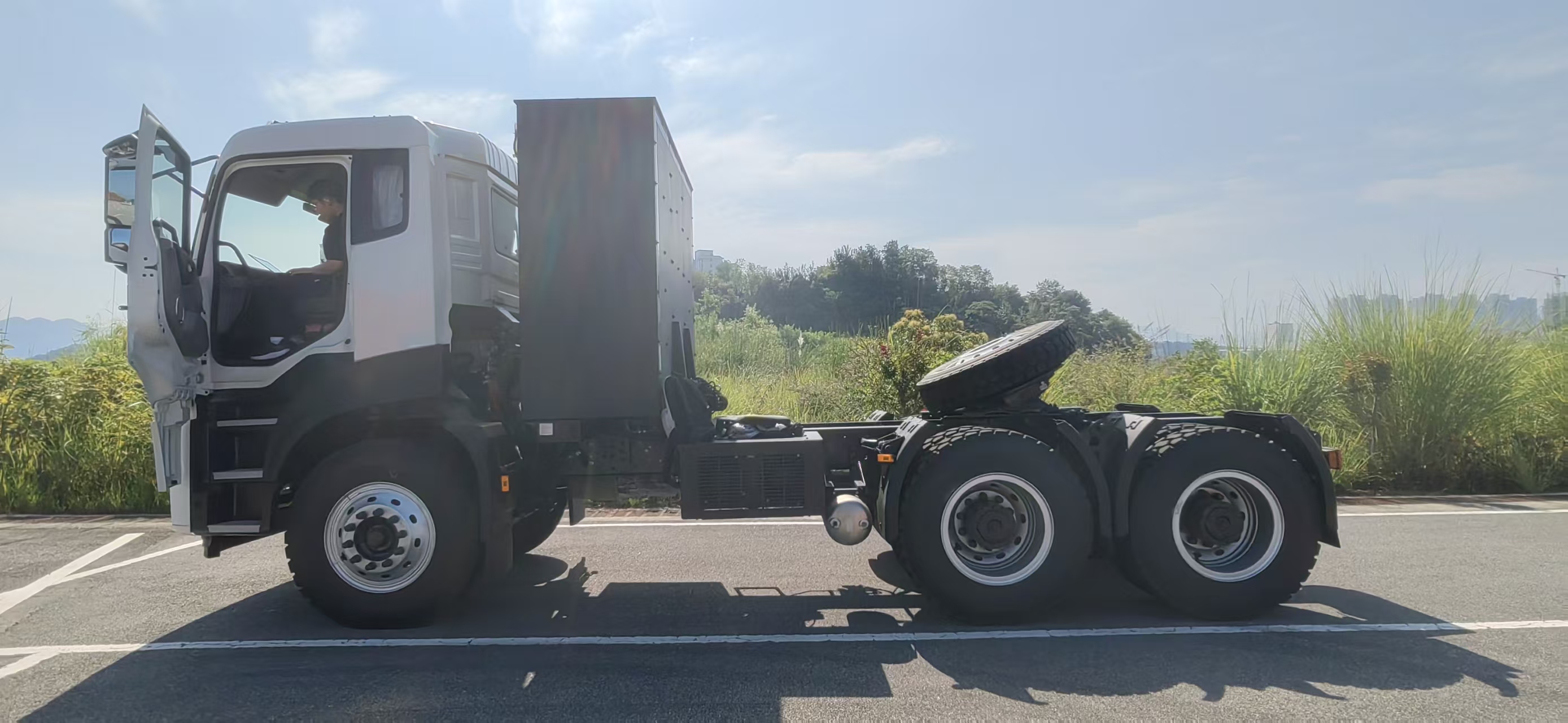
Choose a vehicle configuration that matches a known fleet task. The customer-provided TE9Y worksheet gives one example: a 6×4 electric tractor with 120,000 kg listed gross combination weight and 600.92 kWh battery capacity. It also lists a dual-gun DC charging entry at 600 A. These are configuration fields, not evidence of route range, charging time or local approval. Confirm the production build and all missing interface details before a pilot.
| TE9Y worksheet item | Listed value | Pilot implication |
|---|---|---|
| Model code | DFH4250YBEV8-TE9Y-902 | Record actual VIN/build and ordered market specification |
| Layout / GCW | 6×4 / 120,000 kg listed | Measure actual tractor-trailer mass and route constraints |
| Kerb weight | 14,450 kg listed | Verify delivered tare; it is not payload |
| Battery | 600.92 kWh listed | Obtain usable energy and SOC guidance for the exact vehicle |
| Motor | 315 kW rated / 510 kW peak listed | Do not treat peak output as sustained route performance |
| Charging | Dual-gun DC, 600 A listed | Confirm inlet, charge curve, rating basis and site charger |
| Wheelbase / dimensions | 3,800 + 1,450 mm / 7,795 × 2,550 × 3,270 mm | Check trailer fit, turning envelope and charging-bay geometry |
See the TE9Y Pakistan configuration guide and the route and charging planning article. The worksheet does not supply a verified range or pilot result.
Define a decision question before selecting vehicles
A useful pilot tests a specific operational question, such as whether a fixed shuttle can complete its scheduled cycle with the site's available charging window, or whether a selected cargo route can maintain deliveries without changing the service promise. Avoid a vague objective such as “test electric trucks.” Write down the current operating requirement, acceptable service level, constraints and what evidence would justify a next step.
Choose representative routes and shifts rather than the easiest available assignment. Include loaded and empty legs, grades, surface, stop frequency, queuing, turnaround, weather, trailer or body and daily schedule. If the pilot covers only one route or season, state that boundary so the result is not generalized to other work.
Set a pilot owner and decision group across fleet operations, drivers, maintenance, facilities, finance, procurement, safety and the supplier. Decide who provides route and vehicle data, how incidents are escalated and who can pause the test.
Collect a baseline and agree on the measurement plan
Before deployment, capture how the current task operates: distance, trip time, payload or combination mass, stops, energy/fuel, downtime, schedule adherence, maintenance and driver workload. Document how each measure is calculated and which system is the source. A comparable baseline lets the team evaluate service and cost without attributing every difference to the powertrain.
For the pilot vehicle, collect the route profile, odometer, departure and arrival times, state of charge, charging sessions, energy added, load, ambient conditions, auxiliary use, alerts, downtime and maintenance actions. Capture charger availability and any queue or site-power constraint. The U.S. Department of Energy's federal fleet guidance describes telematics data such as vehicle use, distance, state of charge and charging energy as useful planning inputs; use the vehicle and charger data actually available for your selected model. See DOE telematics guidance.
Set measurement quality rules: consistent units, driver logs for missing data, treatment of exceptional trips, privacy access and review cadence. Do not use an unsupported telematics adapter or alter a vehicle system without approval. If data are unavailable, say so and use a documented manual process.
Prepare the depot, charger and staff before delivery
Map vehicle parking and charger locations, electrical service, charger output, cable reach, traffic movement, access hours and the actual dwell window. Confirm compatibility with the truck supplier and charger provider, including inlet, communications, operating conditions and commissioning. A current rating by itself does not establish charge time; the vehicle charge curve, charger capability, site supply, starting state of charge and operating temperature all matter.
Coordinate early with the utility, landlord, electrical designer, installer and supplier. Decide who owns permits, civil work, equipment, commissioning, maintenance and contingency charging. A DOE/AFDC fleet toolkit recommends evaluating facility capacity, route and vehicle operating profiles, data tools, workforce skills and phased implementation as part of electrification planning. Its guidance is general and must be adapted to the site and local requirements.
Train drivers in vehicle controls, charging steps, warnings, route contingencies and reporting. Train technicians and facilities staff within manufacturer-approved scopes. Agree on emergency contacts and a supplier escalation path. The overseas parts and after-sales plan can help identify which support questions to resolve before launch.
Run the pilot in controlled phases
A practical project may use readiness, limited-operation and evaluation phases; the dates should reflect vehicle delivery, route repetition and data sufficiency rather than an arbitrary number of days. Before the first trip, close safety-critical issues, confirm the final vehicle configuration, test charger connection, complete a route walk-through and brief drivers. Record any open non-critical items and owners.
Begin with a supervised duty cycle and clear stop criteria. Increase route exposure only after the team has reviewed the initial results. Keep the route, load and shift as consistent as practical when comparing runs. Log deviations—detours, unusually long queues, charger interruptions or weather changes—rather than deleting them from the dataset. Review energy and service performance regularly with operations, maintenance, facilities and the supplier.
Do not change the SOC reserve, charging procedure, route, body or software during a comparison without recording the change. Follow the manufacturer's safe operating limits and instructions. A pilot is not a reason to bypass warnings or conduct unapproved tests.
Use decision gates to guide the next investment
Before the pilot, agree criteria for operational fit, charging readiness, vehicle availability, energy performance, maintenance capability, driver acceptance and total cost inputs. Distinguish “pass,” “needs redesign” and “not yet proven.” If a route cannot be completed under the tested conditions, investigate whether the cause is vehicle sizing, schedule, load, infrastructure, data quality or a mismatch between task and vehicle.
At closeout, compare the pilot with the baseline, report sample size and exceptions, list unresolved risks and document assumptions. Decide whether to stop, extend the test, modify the route or charging plan, or expand to a limited next tranche. A successful pilot on one route does not prove all fleet routes are suitable. Scale only after the business case, site plan, training, parts/support and destination approvals are ready.
The AFDC fleet toolkit also recommends phased implementation and planning for future charging needs. Keep infrastructure expansion modular where practical, but have qualified local specialists assess actual demand, utility conditions and cost before committing capital.
Pre-launch checklist
- One defined business question, route, shift and acceptance criteria.
- Final vehicle build, trailer/body configuration and local approval path confirmed.
- Baseline and pilot data fields, sources, owners and privacy rules agreed.
- Depot electrical survey, charger compatibility, installation and commissioning complete.
- Driver, technician, facilities and supplier training completed for assigned roles.
- Stop criteria, breakdown response, alternate charging and escalation documented.
- Decision gates and scale-up requirements agreed before results are known.
To scope a pilot, share country, vehicle model, route map, load, daily schedule, depot power, charger specification and fleet size through the configuration enquiry page. Review the electric truck TCO framework and charging compatibility checklist as related planning references.
Frequently asked questions
How long should an electric truck pilot last?
There is no universal duration. Continue until representative routes, operating conditions and charging periods have been observed and the agreed decision data are sufficient.
Can the TE9Y worksheet establish a route range?
No. It lists battery capacity but not a verified route range. Measure the actual combination under a documented duty cycle and confirm usable energy with the supplier.
What is the most important pilot metric?
No single metric is enough. Evaluate service completion, charging fit, energy, uptime, maintenance and cost assumptions together against the business requirement.
PILOT PLANNING
Preparing a first electric truck deployment?
Share a real route, schedule, load and charger plan to structure a measurable pilot.
Request a ConfigurationGeneral fleet references: DOE/AFDC Electric Vehicle Fleet Toolkit and DOE telematics guidance.