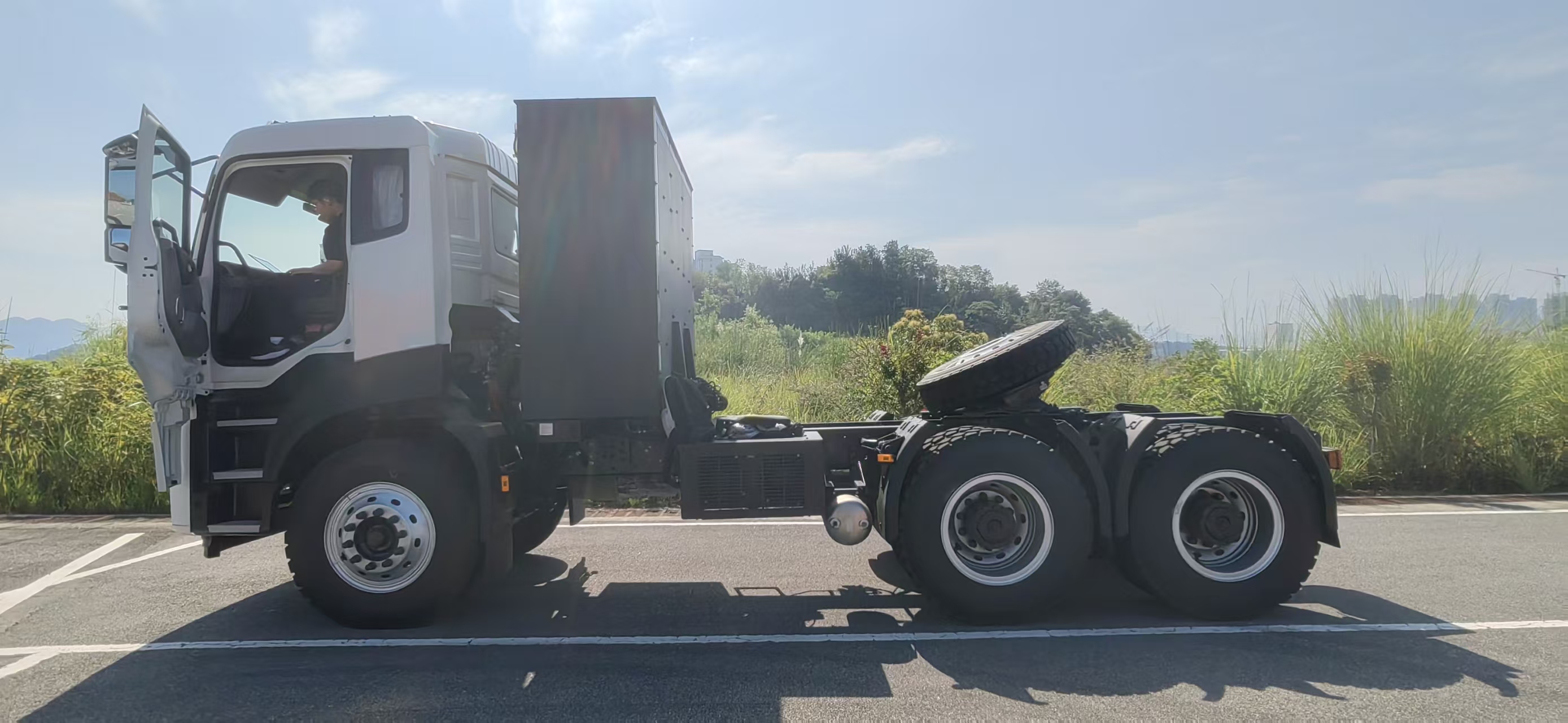
Use a specific vehicle configuration as the starting point
The supplied TE9Y worksheet describes a 6×4 electric tractor intended for a Pakistan-market project. It provides configuration fields, but does not supply hot-climate test results, battery temperature limits, a validated route range or a cooling-system performance curve. The summary below keeps those distinctions visible.
| Worksheet item | Listed value | Hot-weather planning note |
|---|---|---|
| Model code | DFH4250YBEV8-TE9Y-902 | Confirm production build and market equipment |
| Drive layout / GCW | 6×4 / 120,000 kg listed | Route suitability depends on complete combination and limits |
| Battery capacity | 600.92 kWh listed | Usable energy and temperature window are not defined in the worksheet |
| Motor | TZ460XS-LKM2810; 315 kW rated / 510 kW peak | Not a continuous-performance or thermal-derating guarantee |
| Charging entry | Dual-gun DC, 600 A | Confirm rating basis, charge curve, inlet and thermal conditions |
| Dimensions | 7,795 × 2,550 × 3,270 mm | Check shaded parking, ventilation and charger-bay access |
For the full source notes, see the TE9Y Pakistan configuration article. A capacity number alone cannot predict performance during a hot shift.
Separate ambient heat from the vehicle's own thermal loads
Heat planning is not just a battery topic. Traction, power electronics, motor, battery, cabin air conditioning, cooling pumps and body equipment may all shape energy use or availability. The exact architecture, limits and control strategy belong to the vehicle manufacturer's documentation. Do not assume the truck uses a particular coolant loop, preconditioning mode or charging derate unless it is confirmed for the ordered model.
The U.S. Department of Energy's Alternative Fuels Data Center advises fleet planners to consider weather, battery temperature limits, heating or cooling loads, auxiliary equipment, routes and dwell times when evaluating electric vehicles. It also notes that in extreme climates the charging location may need to account for battery and equipment temperature limits. Those are planning prompts, not model-specific claims about the TE9Y. Review the official AFDC electric-vehicle fleet guidance and then obtain the manufacturer limits for the actual truck.
Operationally, distinguish heat exposure while driving, waiting, charging and parked. A truck queueing in direct sun with a loaded trailer has a different duty from a vehicle parked in a ventilated depot. Record ambient conditions and dwell periods alongside energy data so a fleet can see which part of the work pattern is driving changes.
Build a route test that reflects the demanding shift
Map the whole work cycle: loaded and empty legs, start times, road grade, surface, speed bands, traffic, queueing, turnaround, stops and charging opportunities. Record the combination mass and trailer. For a heavy tractor, avoid extrapolating from a light-load run or a short demonstration. Select a representative demanding day, then define a conservative planning case that includes diversions and equipment downtime.
During a controlled pilot, capture start and end state of charge, distance, elevation, load, ambient conditions, auxiliary use, alerts and energy returned by the charger. Use consistent measurement intervals and make sure drivers know how to report warnings without bypassing the vehicle's protection systems. Compare like-for-like shifts; a difference in route, load, driver, or waiting time can make a simple before-and-after comparison misleading.
Set a dispatch reserve from measured evidence and the agreed fleet policy. Establish what dispatch should do if consumption departs from expectation: shorten the route, add a charging stop, switch a vehicle or pause the duty for technical review. Do not use a single optimistic shift as a permanent range promise.
Plan charger conditions and parked-vehicle exposure
Before deployment, ask the truck supplier for the approved ambient and battery temperature limits for charging and operation, the relevant alerts, and what the vehicle does when those limits are approached. Ask the charger supplier to confirm its own environmental operating range, derating behavior and installation requirements. These limits may differ between vehicle, charger and site equipment, so design around the most restrictive documented condition.
Survey the depot for electrical service capacity, transformer and switchgear constraints, charger placement, cable reach, ventilation, shade, drainage and safe traffic flow. Confirm whether charging can happen during the actual dwell window and how the fleet will operate if a charger is unavailable. The worksheet's “dual-gun 600 A” entry does not state voltage, charge curve, connector protocol or whether the current is per gun or combined. It cannot be converted into a reliable charge time without those details. See the charger compatibility buyer checklist and 600 kWh tractor charging plan.
Where practical, plan parking and charging locations to reduce unnecessary solar exposure while preserving the manufacturer's required clearances and ventilation. Do not add a shelter, enclosure or cooling measure that conflicts with charger or vehicle installation instructions. A qualified site designer should confirm the solution.
Use maintenance and driver procedures that preserve evidence
Follow the manufacturer's inspection and service schedule for cooling systems, filters, coolant, electrical connections and diagnostic alerts. Do not top up, open or modify high-voltage or thermal circuits outside the approved procedure. Train drivers to recognize warnings, record the conditions and use the specified escalation channel. A warning should not be treated as a nuisance to clear without diagnosis.
Review telemetry after the first hot-weather weeks and after route, body or charger changes. Look for repeatable changes in energy use, charging duration, alerts and downtime rather than reacting to one unusual shift. Keep records for the truck, charger and site together. That makes it easier to distinguish a vehicle issue from a site supply, charger or duty-cycle issue.
Define heat-related contingencies: alternate charging bays, dispatch thresholds, safe vehicle parking, breakdown response and parts/support contacts. The exact response should come from the vehicle and charger manuals and local emergency procedures. This article is a fleet planning guide, not a substitute for those instructions.
Hot-climate electric truck checklist
- Obtain written vehicle operating, charging and battery temperature limits for the exact build.
- Confirm charger environmental limits, connector, communications and any derating behavior.
- Record route, load, ambient conditions, dwell time, auxiliary use and energy for representative shifts.
- Define reserve, dispatch thresholds and a plan for charger downtime.
- Survey shade, ventilation, charger placement, cable routing and site power with qualified designers.
- Train drivers and technicians on warnings, approved procedures and escalation paths.
- Review data after heat waves, route changes, body additions and charger modifications.
- For export projects, verify destination-market approval independently with qualified local partners.
To assess a route, share the country, combination mass, route profile, shift timing, expected stops and depot charger details through the configuration enquiry page. Related reading: Pakistan TE9Y route and charging planning and body upfit and auxiliary-power planning.
Frequently asked questions
Does the TE9Y's listed 600.92 kWh battery guarantee a hot-weather range?
No. The worksheet does not state validated range or usable energy. Use route-specific measurements and manufacturer operating limits.
Can I charge immediately after a hot shift?
Follow the exact vehicle and charger instructions. Ask the supplier to confirm allowed temperature conditions and any thermal conditioning behavior.
What should the fleet track?
Record route, load, ambient conditions, state of charge, energy, charger duration and alerts using approved vehicle procedures.
FLEET PLANNING
Evaluating an electric truck in a hot region?
Share a representative route, shift, trailer and charging plan for a configuration review.
Request a ConfigurationFurther reading: U.S. Department of Energy, Alternative Fuels Data Center: Electric Vehicles for Fleets. Consult the applicable vehicle and charger manuals for model-specific limits.